Laser Lithotripsy is the most advanced, minimally invasive procedure for treating kidney, ureteral, and bladder stones. A thin flexible scope (ureteroscope) is passed through the natural urinary passage — no cuts, no stitches — and a laser fibre is used to precisely fragment or dust the stone into fine powder, which then passes out naturally with urine. Dr. Chirag Gupta at Jaipur uses the latest generation laser technology — Holmium YAG and Thulium Fiber Laser (TFL) — to achieve the best stone-free rates with minimal discomfort and rapid recovery.
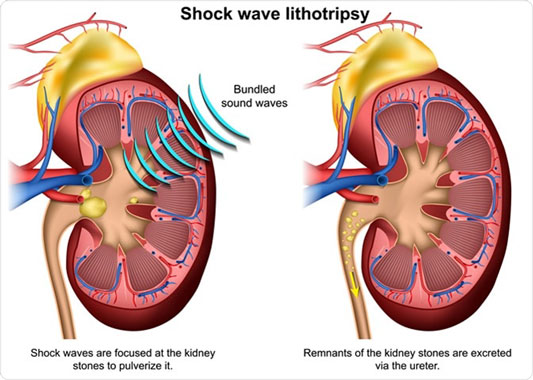


The procedure is performed under general or spinal anaesthesia. A thin, flexible ureteroscope is introduced through the urethra into the ureter or kidney without any external incision. A laser fibre (as thin as a hair) is passed through the scope and positioned directly over the stone. Laser pulses are then fired to either:
A temporary ureteric stent is usually placed at the end of the procedure to prevent swelling and ensure smooth urine drainage. The stent is removed after 1–2 weeks in clinic.
The Holmium:YAG (Ho:YAG) laser has been the gold standard in endourological stone treatment for over 25 years. It operates at a wavelength of 2,100 nm and works through a photothermal mechanism, making it effective against all stone compositions — including the hardest calcium oxalate monohydrate and cystine stones.
Holmium laser can fragment uric acid, struvite, calcium oxalate, cystine, and even the hardest stones with ease.
Achieves excellent stone clearance in single session, especially for stones up to 2 cm.
Advanced pulse modulation in newer Holmium systems reduces stone retropulsion and increases efficiency by up to 3×.
Minimal thermal damage to surrounding tissue, with decades of clinical validation.
The Thulium Fiber Laser (TFL) represents the latest leap in laser lithotripsy technology. Operating at a wavelength of 1,940 nm — closer to the absorption peak of water — it delivers superior stone vaporisation with lower peak power. TFL is up to 4 times more efficient than conventional Holmium lasers for stone dusting.
TFL produces ultra-fine stone dust (pop-corn effect) making spontaneous stone passage easier, reducing need for basket retrieval.
Smaller pulse energy means the stone moves less during treatment — allowing faster, more precise surgery.
TFL fibres are as thin as 50–150 µm, enabling use through the smallest flexible ureteroscopes for kidney access.
TFL can fire up to 2,200 Hz compared to Holmium's 80 Hz, allowing significantly faster stone ablation and shorter surgery time.
| Parameter | Holmium YAG | Thulium Fiber (TFL) |
|---|---|---|
| Wavelength | 2,100 nm | 1,940 nm |
| Mechanism | Photothermal | Photothermal (water absorption) |
| Pulse Frequency | Up to 80 Hz | Up to 2,200 Hz |
| Stone Retropulsion | Moderate | Very Low |
| Dusting Efficiency | Good | Excellent (4× better) |
| Fibre Size | 200–1000 µm | 50–150 µm |
| Stone Types Treated | All | All |
| Clinical Experience | 25+ years (Gold Standard) | Newer – rapidly growing evidence |
Laser Lithotripsy is recommended for:
Dr. Chirag Gupta is an experienced Urologist and Endourologist in Jaipur with
expertise in flexible ureteroscopy and advanced laser stone surgery. He uses the latest Holmium and
Thulium laser systems to deliver the best possible outcomes for kidney and ureteral stone patients.
Book Consultation

Dr. Chirag Gupta is a leading Urologist, Andrologist & Microsurgeon in Jaipur with expertise in advanced endourology and laser stone surgery.
Consultation