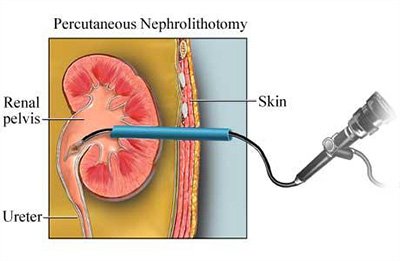
Percutaneous Nephrolithotomy (PCNL) is the internationally recognized gold-standard procedure for the removal of large, complex, or hard kidney stones (typically greater than 2 cm or 20 mm in diameter), including staghorn calculi.
Instead of open surgery that required a large 15–20 cm incision and weeks of bed rest, PCNL is performed through a tiny "keyhole" access (approx. 1 cm) created in the patient's flank directly into the kidney. Under high-definition endoscopic and fluoroscopic guidance, advanced lithotripsy devices (ultrasonic, pneumatic, or laser) break the stone and continuously extract all fragments, providing the highest single-stage stone clearance rate.
Every kidney stone is unique. The choice of treatment depends on the size, hardness, location of the stone, and the patient's individual anatomy. Below is a comprehensive comparison of all modern stone treatments available at Dr. Chirag Urology:
| Treatment Option | Ideal Stone Size | Surgical Entry / Cut | Energy Source Used | Stone Clearance | Hospital Stay |
|---|---|---|---|---|---|
|
Standard PCNL (Keyhole Nephrolithotomy) |
> 2.0 cm (20 mm+) Staghorn / Multiple stones |
Keyhole back puncture (~1 cm) | Ultrasonic, Pneumatic & Laser Lithoclast | Highest (>95%) Single session |
1 to 2 Days |
|
Mini PCNL / Micro PCNL View Micro PCNL |
1.0 cm to 2.0 cm Lower pole kidney stones |
Pinhole puncture (<1.6 mm - 4 mm) | High-power Holmium / Thulium Laser | Very High (>90-95%) | 24 Hours (Next-day discharge) |
|
RIRS View RIRS Page |
< 2.0 cm (up to 20 mm) Kidney stones (all calyces) |
Zero Skin Cuts (Natural urinary passage) |
Flexible Scope + Laser Dusting (200 µm) | High (85% – 92%) Sand passes in urine |
Day-care or 24 Hours |
|
ESWL (Lithotripsy) View ESWL Page |
< 1.0 cm (up to 10 mm) Soft upper/mid kidney stones |
Completely Non-Invasive (Outside the body) |
Extracorporeal Shock Waves (Acoustic) | Moderate (70% – 80%) (May need 2+ sessions) |
Outpatient (Discharged in 2-3 hrs) |
|
URS (Ureteroscopy) View URS Page |
Any Size in Ureter (Ureteric stones) |
Zero Skin Cuts (Natural urinary passage) |
Semi-Rigid Scope + Holmium Laser | Very High (>95%) Instant relief |
Day-care / 24 Hours |
To determine which surgical option guarantees highest stone clearance with the fastest recovery, a thorough diagnostic assessment is conducted:
Have a CT scan or ultrasound report? Consult with Dr. Chirag Gupta to discuss whether PCNL, Mini PCNL, or scarless RIRS is the safest and most effective option for your stone.

We must explain to you how all seds this mistakens idea off denouncing pleasures and praising pain was born and I will give you a completed accounts off the system and expound.
Consultation